The term "AI employee" gets used loosely. Vendors apply it to chatbots, to automation scripts, to copilot tools that need a human to prompt every step. None of those are AI employees.
An AI employee is something more specific — and more capable. It's an intelligent system with a role, a memory, access to your tools, and the ability to complete real work independently. It learns your business over time. It doesn't need to be told the same thing twice. And unlike traditional automation, it can handle judgment, not just tasks.
This is what the shift from AI tools to AI employees actually looks like — and why forward-thinking teams are making it now.
What's the Difference Between an AI Tool and an AI Employee?
Most AI tools are task-specific: they do one thing in response to a prompt. They generate text, summarize a document, classify data, or draft a reply. Useful — but passive. Someone still has to direct every action.
AI employees are role-based: they own a function within your business. A content writer AI employee doesn't just write when asked — it monitors publishing schedules, surfaces content opportunities, drafts posts, submits for review, and tracks performance. It's working, not waiting.
The distinction comes down to four things:
- Scope — AI tools handle discrete tasks; AI employees own ongoing responsibilities
- Memory — AI tools start fresh every time; AI employees retain context across sessions, clients, and time
- Initiative — AI tools respond to prompts; AI employees can trigger their own workflows based on events
- Learning — AI tools don't get better at your business; AI employees adapt to your processes, terminology, and standards
Why Traditional Automation Falls Short
Businesses have been automating for years — Zapier, Make, n8n, custom scripts. These tools are genuinely useful for connecting apps and routing data. But they hit a wall fast.
Traditional automation can't handle:
- Variable inputs — a workflow that works when the data is clean breaks when it isn't
- Ambiguity — rigid scripts can't make judgment calls when context is unclear
- Context — most automation has no memory; every run is stateless
- Unstructured tasks — research, drafting, analysis, and communication don't fit in trigger-action models
AI employees don't replace automation. They sit above it. They use structured workflows where precision matters, and apply reasoning where it doesn't — choosing the right tool for each step in the process.
How an AI Employee Actually Works
At the technical level, an AI employee combines:
A role and instructions — the scope of what it's responsible for, how it should behave, what it should prioritize, and what it shouldn't do.
Memory — a persistent store of client history, preferences, past decisions, and contextual knowledge that grows over time.
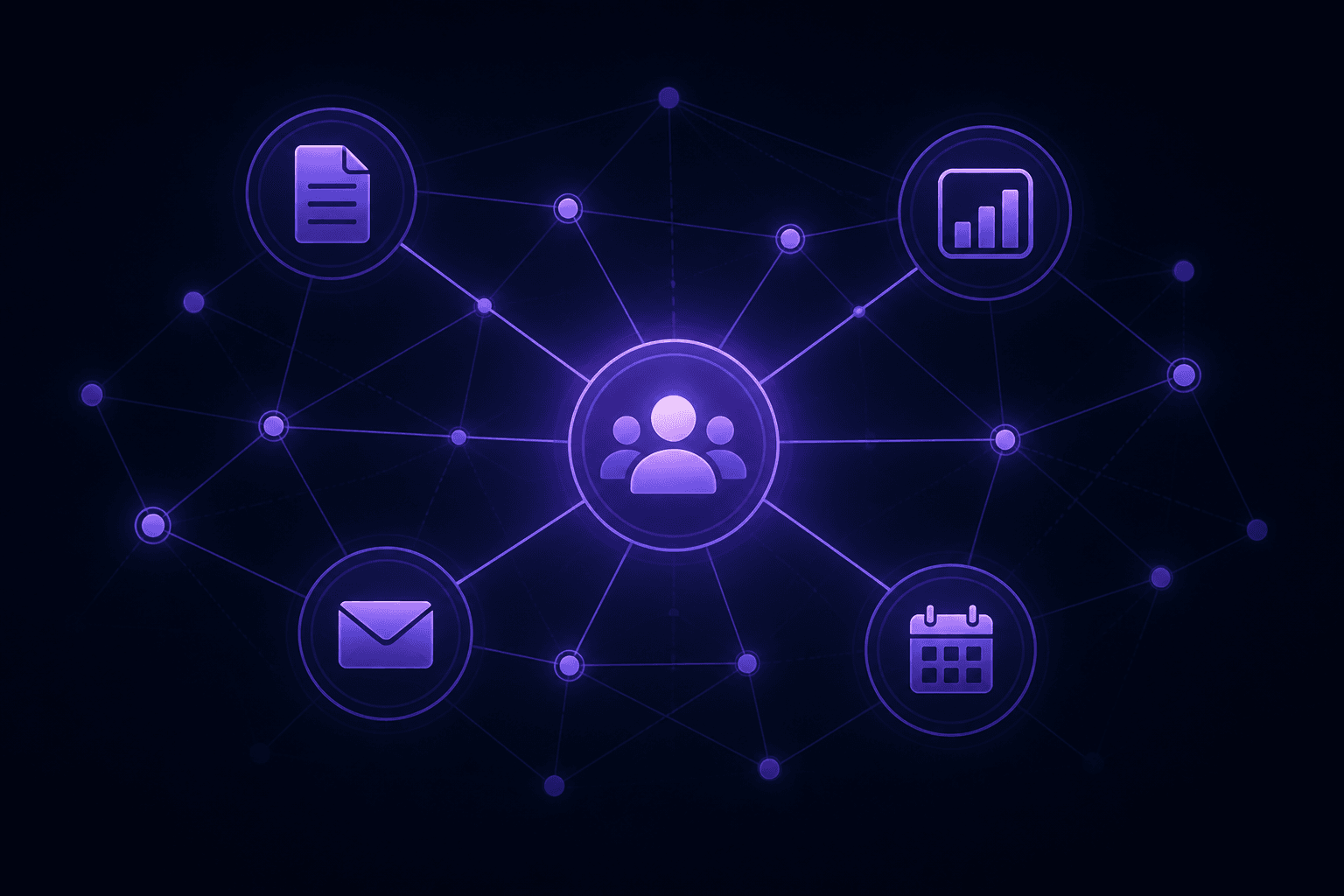
Tool access — integrations with the platforms your business runs on: email, CRM, document systems, communication channels, calendars, databases.
Workflow capability — both structured, no-code workflows for repeatable processes and autonomous reasoning loops for undefined tasks.
Event triggers — the ability to start work when something happens (a new email, a form submission, a calendar event) without waiting for a manual prompt.
When these components work together, you get something that functions like a real employee rather than a piece of software.
What AI Employees Are Good At
The sweet spot for AI employees is high-volume, context-heavy, repeatable work that eats the time of skilled people:
- Client communications — drafting responses, following up, maintaining relationship context across conversations
- Document generation — producing contracts, reports, proposals, and compliance packages from templates and data. See how Odella handles structured DOCX automation.
- Research and analysis — gathering competitive intelligence, summarizing sources, tracking market changes
- Operations — processing invoices, updating CRM records, routing leads, managing onboarding steps
- Content production — writing, editing, scheduling, and reporting on content at scale
- Compliance and review — flagging issues, checking against rules, maintaining audit trails
The work that AI employees are not ideal for: high-stakes decisions, creative strategy, relationship-building with key clients, novel problem-solving without precedent. That work stays with your people.
The Business Case: Scale Without Hiring
The fundamental value proposition is straightforward. Headcount is expensive and slow to add. Knowledge work keeps growing. The gap between the two widens every year.
AI employees close that gap. They handle the high-volume work so your team can stay focused on what requires their judgment. You scale output without scaling payroll.
For teams in legal, fintech, lending, and professional services — industries where precision is non-negotiable and margin is tight — this is structural leverage. The same team produces more, faster, with a full audit trail. See how Fiskil used AI employees to accelerate CDR compliance onboarding for a real-world example.
What to Look for in an AI Employee Platform
If you're evaluating options, the questions that matter most:
Does it retain memory across sessions? A system that starts fresh every time isn't an AI employee — it's a better chatbot.
Can it connect to the tools you already use? Integration depth determines how much real work it can actually do.
Is there a structured workflow layer? Pure autonomy isn't enough for regulated or repeatable processes. You need the ability to define exact steps when precision matters.
Can you see what it did? Full audit logs aren't optional for professional environments. If the system can't tell you exactly what steps it took, you can't trust it with anything important.
Does it get better over time? The value of an AI employee compounds. A system that doesn't learn from interaction isn't growing with your business.
Odella was built around all five. See what the Odella AI workforce platform is and how it works →
AI employees for business aren't a future concept. They're a present-day competitive advantage — available now, deployable in minutes, and built to compound in value the more they work.