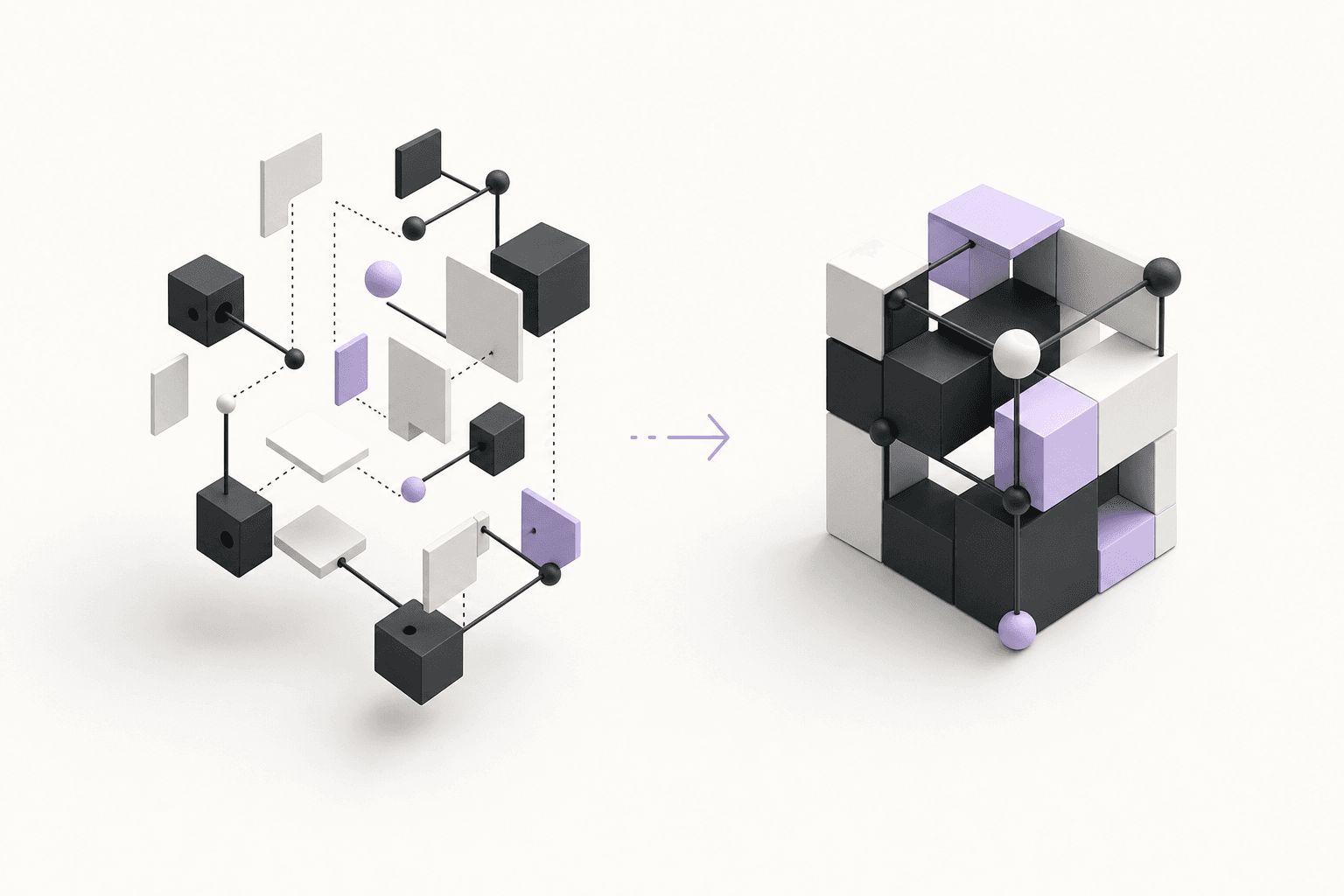
Most AI systems are boxes someone else built. A developer writes the prompt, wires up the tools, defines the guardrails, and ships it. The agent inside runs the same loop forever — capable, maybe, but frozen. When the work changes, a human has to open the box and rewire it.
That's the ceiling almost every "AI agent" hits today. The intelligence is real, but the harness around it — the shell that decides what the agent can do, how it responds to events, what instructions it follows — is static. It only changes when an engineer changes it.
At Odella, we've been building toward a different answer to a simple question: what if the agent could reshape its own harness?
First, what a harness actually is
Before an agent can improve itself, it needs something real to operate. Every Odella AI employee runs inside its own secure remote sandbox — effectively its own computer. Not a chat window with a few API calls bolted on, but a full environment the agent genuinely owns.
Inside that sandbox, the agent can:
- Run programs and write code to solve problems that don't have a pre-built button.
- Drive a real browser to research, log into tools, and complete tasks on the live web.
- Create and edit documents — spreadsheets, slides, reports — the same productivity work a person would do.
- Control its own machine — install what it needs, manage files, orchestrate long-running processes.
This is the harness: the runtime, the tools, the permissions, and the orchestration layer that turns a language model into something that can actually get work done. A top-tier harness is table stakes. It's what separates an agent that can do things from a chatbot that can only talk about them.
But a great static harness still has the same problem as every other box: it stops where its builder stopped.
The two ways an agent can evolve
We think about self-improvement in two layers. The first is the one most people mean when they say an AI "learns." The second is the one almost nobody is building — and it's where the real leverage is.
Layer one: the agent adapts what it knows
An Odella employee doesn't reset every morning. It carries persistent memory across sessions, so it accumulates context the way a real colleague does — your tools, your preferences, past decisions, the reasons behind them.
On top of memory sits dynamic skills: reusable capabilities the agent can acquire and refine over time. It learns your brand and tone of voice and starts producing work that sounds like you, not like a generic model. It learns from mistakes — a correction today becomes a standing rule tomorrow. The longer it works with you, the more it fits.
This is meaningful, and it's already how our agents get better week over week. But notice what it doesn't touch: the agent is getting smarter inside its harness. The harness itself hasn't changed.
Layer two: the agent adapts its harness
This is the harder, more interesting frontier. Instead of only improving what it knows, the agent adapts the shell that orchestrates it — the very structure that determines how it behaves.
Concretely, that means an agent can:
- Reshape its own instructions. As it learns how a role really works, it can rewrite the standing guidance that governs its day-to-day behavior — refining priorities, sharpening its own operating rules.
- Respond to new events. When a new kind of trigger appears — an email pattern, a recurring report, a system alert — the agent can set up the machinery to watch for it and act, without waiting for someone to hard-code that flow.
- Take on new tasks. Rather than being limited to the tasks it was deployed with, it can define new recurring jobs, schedule its own follow-ups, and expand its remit as the work demands.
- Change how it changes. The orchestration layer stops being a fixed cage and becomes something the agent can adjust in response to what the job actually needs.
An agent that can do this isn't just executing a workflow. It's maintaining itself — closing the gap between "what I was set up to do" and "what this role now requires."
Why this matters if you're deploying AI at work
The practical payoff is durability. A static agent is only as good as the day it was configured; the world drifts away from it, and someone has to keep dragging it back. A self-adapting agent moves with the work.
- Less babysitting. You don't file a ticket every time the job changes shape. The agent adjusts.
- Compounding value. Memory, skills, and harness all improve together, so month six is meaningfully better than month one — not the same loop running on repeat.
- Real ownership of a role. This is the difference between automating a task and hiring an employee. An employee grows into the job. That's the bar we're building to — and it's what makes AI employees for business fundamentally different from the tools that came before them.
The honest guardrails
Self-modification is powerful, which is exactly why it can't be unbounded. An agent that can rewrite its own instructions and spin up new behaviors needs to do so under supervision, not around it.
That's why adaptation at Odella happens inside firm limits: agents operate with human oversight, defer on sensitive or irreversible actions, and never quietly weaken their own safeguards. Transparency is a first-class feature — you can see what an agent changed and why. The goal isn't an AI that escapes its constraints; it's one that improves within them, and shows its work.
Freedom and accountability aren't in tension here. The most useful agent is the one you can trust to adapt and trust to stay inside the lines.
The shape of what's coming
The industry spent the last few years proving that language models can reason. The next chapter is about giving that reasoning a body it owns and a shell it can reshape — an agent that runs its own computer, remembers, learns your voice, and adapts the very structure that orchestrates it.
That's the goal behind every Odella AI employee: not a smarter box, but a colleague that outgrows the box entirely — responsibly.
If you want to see where this starts, our guide to what AI employees are lays out the foundation, and our take on structuring workflows for smarter autonomous AI goes a level deeper on the orchestration side.
Curious what a self-adapting AI employee could own in your business? Explore Odella's AI employees or get started free.