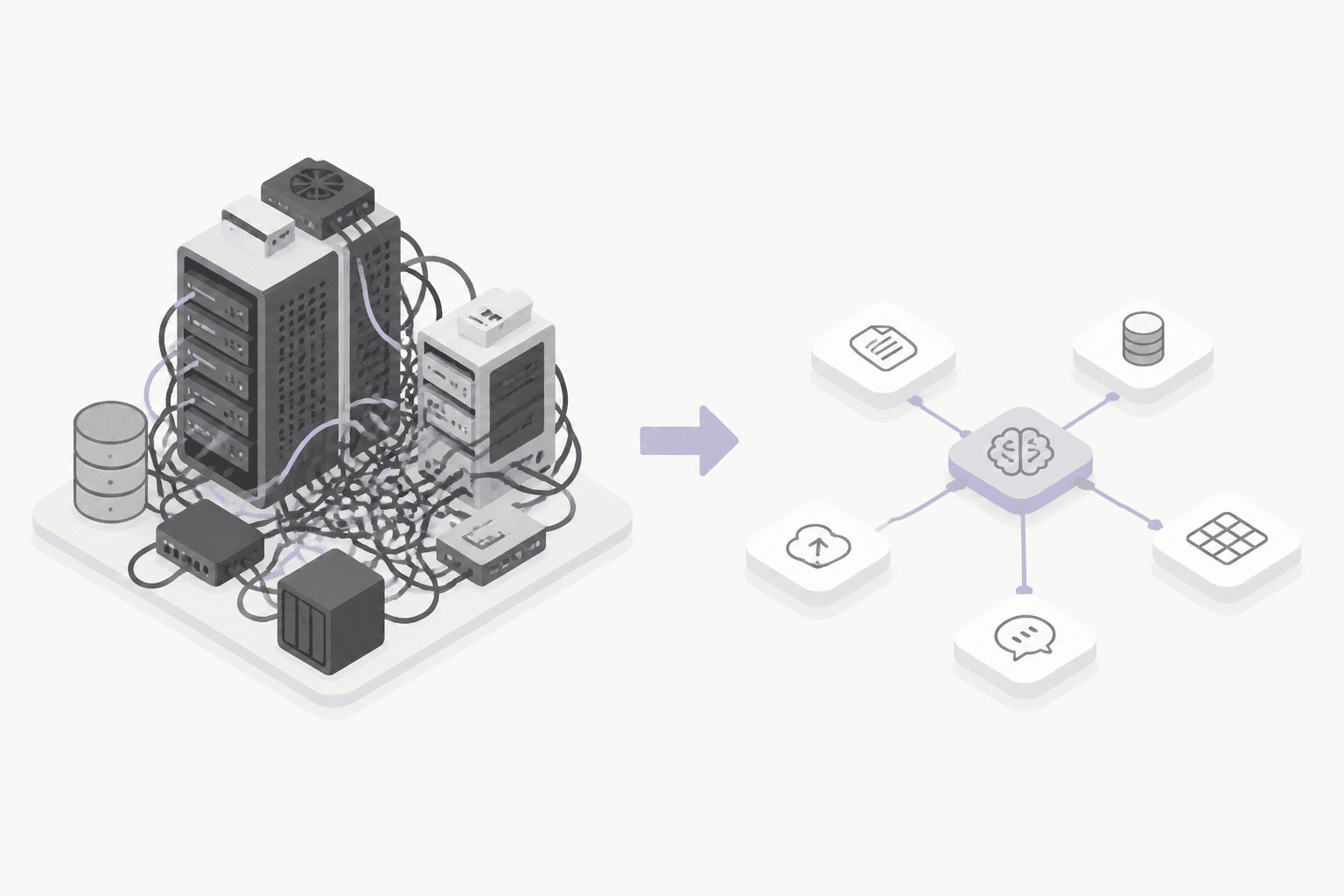
n8n earned its spot as the default pick for technical teams that wanted automation without vendor lock-in — open-source, self-hostable, billed by execution instead of by task. That model still works well for a specific kind of team. But n8n also has a real floor: it expects engineering resources to self-host, update, and secure, and even on its cloud plans, it's still fundamentally a rules engine. It runs the flow you built, exactly as you built it, and stops the moment a scenario falls outside those rules.
If you're evaluating n8n alternatives in 2026, the real question isn't just "what's easier to set up" or "what's cheaper to run." It's whether you need a rule-based workflow tool at all, or whether the job you're trying to automate is really a role — ongoing, judgment-heavy, and full of edge cases no flowchart fully captures.
This guide breaks down seven of the strongest n8n alternatives in 2026 — what each does well, where it falls short, current pricing, and the type of team it fits. (Starting from Zapier instead? Our companion Zapier alternatives 2026 guide covers the same seven platforms from that angle. Specifically comparing Lindy? See our dedicated Lindy AI alternative guide.)
Why teams look past n8n
Two reasons come up consistently.
1. Self-hosting is a real commitment. n8n's free self-hosted Community Edition has unlimited executions and the full integration catalog — genuinely excellent value. But "free" means you own updates, security patches, and uptime. For teams without dedicated infrastructure resources, that's a hidden cost n8n Cloud pricing doesn't show. n8n Cloud starts around $20–24/month for the Starter tier (2,500 executions), with Pro around $50–60/month for 10,000 executions, and a self-hosted Business tier near $800/month for SSO and Git — features that used to be more broadly available before the 2025/2026 pricing shift. (Pricing verified against public vendor sources, July 2026; always confirm current rates.)
2. It's still rule-based automation. n8n added AI nodes and can call LLMs inside a flow, but the flow itself is deterministic — built once, run the same way every time. When a trigger fires with messy, ambiguous, or unexpected input, n8n doesn't reason about it. It runs the steps you wired or it breaks. As the work you're automating gets less predictable — customer replies, ops exceptions, judgment calls — that ceiling gets hit fast.
Keep both problems in mind. Some alternatives below solve the setup/hosting problem. Others solve the capability ceiling. Only one category — AI employees — is built to solve the second one properly.
The 7 best n8n alternatives in 2026
1. Zapier — best for simple, no-maintenance automation
Zapier is still the fastest way to connect two apps with zero infrastructure to manage. No self-hosting, no server, no updates to own — everything runs on Zapier's cloud. Pricing is task-based: the free plan gives 100 tasks and two-step Zaps, paid plans start around $19.99–$29.99/month for 750 tasks. That's the trade-off versus n8n's execution-based model — task costs climb fast with multi-step, high-volume workflows, while n8n's "one execution regardless of steps" model scales better for complex flows. For the full breakdown of Zapier's alternatives (including this same platform lineup from the other direction), see our Zapier alternatives 2026 guide.
Where it falls short: same ceiling as n8n — rule-based, no reasoning about ambiguous input. And at volume, task-based billing gets expensive quickly.
Best for: teams that want the absolute easiest setup and don't want to think about hosting, ever.
2. Make (formerly Integromat) — best visual builder for complex logic
Make gives you a node-based visual canvas instead of n8n's flow-based one — arguably more intuitive for branching logic, iterators, and multi-path scenarios. Pricing starts around $10.59/month for the Core tier (10,000 operations/credits), and unused operations roll over one month on paid plans. In 2026 Make added native AI agents with MCP support, closing some of the capability gap with newer AI-native tools.
Where it falls short: still fundamentally rule-based under the hood — AI features assist inside flows, they don't own outcomes. High-frequency scenarios can burn through credits quickly at scale.
Best for: teams that want n8n's power with a more polished, cloud-hosted visual builder and don't need self-hosting.
3. Activepieces — best open-source AI-native alternative
Activepieces is the closest philosophical match to n8n — MIT-licensed, fully self-hostable, open catalog of community-built "pieces." Where it diverges is AI-nativity: it supports MCP as both server and client, ships built-in AI agents and an AI Copilot, and includes a human-in-the-loop "Todos" approval system out of the box. Cloud pricing runs a simple $5 per active flow per month with unlimited runs on that flow — no execution-counting anxiety. Self-hosting the whole stack is free.
Where it falls short: integration catalog is smaller than n8n's mature ecosystem, and template depth hasn't caught up yet. Self-hosting still means you own the infrastructure.
Best for: technical teams who like n8n's open-source model but want AI agents and approval workflows built in from day one, without n8n's execution-based cloud pricing.
4. Lindy AI — best for AI agents doing communication work
Lindy skips workflow-building almost entirely — you describe what you want in plain language and an agent handles email triage, meeting notes, scheduling, and follow-ups, learning your voice from feedback. It's the opposite end of the spectrum from n8n's build-it-yourself flow canvas. Pricing runs Plus at $49.99/month, Pro at $99.99/month (3x usage, computer use, model selection), and Max at $199.99/month (7x usage), all on a usage-metered model with no published quota number. For a deeper look at Lindy specifically and how it stacks up against the rest of the field, see our dedicated Lindy AI alternative guide.
Where it falls short: cloud-only — no self-hosting, no local file or hardware access. The usage meter is opaque, and it's built for individual/communication-heavy workflows, not complex multi-system operations n8n handles well.
Best for: individuals or small teams who want an AI agent running their inbox and calendar without building anything.
5. Relay.app — best for human-in-the-loop AI workflows
Relay.app pairs a chat-based AI assistant that builds workflows for you with best-in-class human-in-the-loop controls — you can insert approval checkpoints before any step that matters, which n8n doesn't offer natively. In February 2026 Relay launched a dedicated Agents product, repositioning from "workflow tool" toward AI team builder. Pricing starts around $38/month, scaling to Team at $138/month (2,000 steps, 5,000 AI credits, 10 users).
Where it falls short: smaller integration library than n8n's mature catalog, and it's a younger platform — you may not find a long-tail integration n8n already supports.
Best for: teams that want AI-assisted automation but need approval gates for anything customer-facing or high-stakes.
6. Gumloop — best AI-native visual canvas for content/data pipelines
Gumloop targets the same "build without coding" audience as n8n, but every block can call an LLM, scrape data, or orchestrate multiple agents in one flow — combining automation with AI reasoning natively, not as an add-on. Pricing includes a free tier with paid plans starting around $37/month.
Where it falls short: large multi-step workflows get harder to manage visually as they grow, and the integration/reliability story is newer than n8n's.
Best for: no-code teams building AI-heavy content or data pipelines who want AI baked into the builder from the start.
7. Odella — best for AI employees that own the whole job, not just the workflow
Every tool above — including n8n — asks you to build and maintain a flow. Even the AI-native ones are still automating discrete tasks or running agents inside a workflow you design. Odella is a different category: specialized AI employees that learn your tools and processes, then own an ongoing responsibility end-to-end — the way a capable hire would, not the way a flowchart would.
Instead of wiring triggers and steps, you hire a worker from the marketplace or build your own, connect it to the systems your team already uses, and delegate an outcome — "keep the CRM clean," "triage the support inbox," "draft the weekly ops report." Six capabilities make this structurally different from rule-based tools like n8n:
- Adaptive intelligence — learns how your tools and processes actually fit together, and handles work the way your team would, not the way a generic template assumes.
- Memory that compounds — remembers past decisions, preferences, and context, so output gets better over time instead of resetting on every run.
- Transparency — you can see what a worker did and why, which matters when you're delegating a responsibility rather than triggering a single action.
- Automation on a schedule — recurring responsibilities run without you re-triggering anything.
- Connectivity — plugs into your existing stack and acts inside the apps where the work happens.
- Security — built for teams that need control over what a worker can access and do.
The practical difference: when n8n hits an edge case outside the rules you built, the flow breaks or does the wrong thing silently. An Odella AI employee reasons about the ambiguous input, decides what matters, and flags what a human should review. That's judgment, not rule-following — and it's the gap no amount of additional n8n nodes will close.
The honest trade-off: if what you need really is "when a webhook fires, transform this data and push it to a database," n8n (or Make, or Activepieces) is the right, cheaper tool — don't over-engineer a simple pipeline with an AI employee. Odella earns its place when the thing you're automating is really an ongoing role, not a single deterministic pipeline.
Best for: teams that want to delegate an entire ongoing job and scale output without adding headcount. Get started free or explore the marketplace.
Comparison at a glance
| Tool | Best for | Starting price (2026) | Model |
|---|---|---|---|
| n8n | Self-hosting, technical teams | Free self-hosted / ~$20–24/mo cloud | Rule-based (executions) |
| Zapier | Zero-maintenance simple automation | ~$19.99–29.99/mo | Rule-based (tasks) |
| Make | Visual complex workflows | ~$10.59/mo (Core) | Rule-based + AI assist |
| Activepieces | Open-source, AI-native, budget | Free self-host / ~$5 per flow | Rule-based + AI / MCP |
| Lindy AI | AI agents for comms work | ~$49.99/mo | AI agents (cloud-only) |
| Relay.app | Human-in-the-loop AI workflows | ~$38–138/mo | Rule-based + AI |
| Gumloop | AI-native no-code building | Free / ~$37/mo | AI-first workflows |
| Odella | AI employees owning a role | Get started free | AI employees |
Pricing reflects publicly available information as of July 2026 and changes frequently — always confirm current rates on each vendor's site.
How to choose the right n8n alternative
Match the tool to the shape of the work:
- You want n8n's execution-based economics without self-hosting hassle → Make, for a more polished cloud experience with similar visual-canvas power.
- You want n8n's open-source philosophy but with AI agents built in → Activepieces.
- You want the absolute simplest setup, no engineering required → Zapier, if your volume is low, or Lindy, if the work is communication-heavy.
- You need approval checkpoints before anything ships → Relay.app.
- You're building AI-heavy content or data pipelines on a visual canvas → Gumloop.
- You want to delegate an entire ongoing role — not build and babysit a workflow → Odella.
A useful gut check: if you can write the automation as a clean if this, then that rule and it rarely changes, a workflow tool — n8n included — will serve you well and cost less. If you keep adding exceptions, branches, and "well, it depends" logic trying to encode how a person would actually handle it, you don't need a more complex flow. You need an AI employee.
The bottom line
n8n remains a strong choice for technical teams that want control, data sovereignty, and predictable execution-based pricing — and its self-hosted Community Edition is genuinely hard to beat on cost. But it's still a rules engine, and every alternative on this list inherits that same structural ceiling to some degree, even the AI-native ones: they automate tasks or run agents inside workflows a human designed and maintains.
The work that never fits cleanly into that model — the ongoing, context-heavy, judgment-filled responsibilities that quietly eat a team's week — is the gap AI employees for business were built to fill. Instead of building and maintaining a flow, Odella lets you delegate the role: hire a specialized worker, connect it to your tools, and scale your team's output without scaling headcount.
Want to see what delegating a whole role feels like instead of building another workflow? Explore the Odella marketplace, build your own AI employee, or get started free. Prefer to talk it through? Schedule a call.